The inspection exists because guessing is expensive. Accokeek sits on wooded and half-acre-plus lots where the pest pressure comes from outside — the woodland edge along Bryan Point Road, the low wet ground near the…
The inspection exists because guessing is expensive. Accokeek sits on wooded and half-acre-plus lots where the pest pressure comes from outside — the woodland edge along Bryan Point Road, the low wet ground near the Farmington Road Wetlands Special Conservation Area, the creek drainages feeding toward Mattawoman Creek and the Piscataway Park shoreline. Homes in Moyaone Reserve and older sections of Manokeek and Cactus Hill often sit on crawl spaces with unsealed sill plates, open dryer vents, and pipe penetrations that were never foamed. Those are the doors. Spraying a baseboard does not close them, which is why the same mice show up every October and the same ants show up every April.
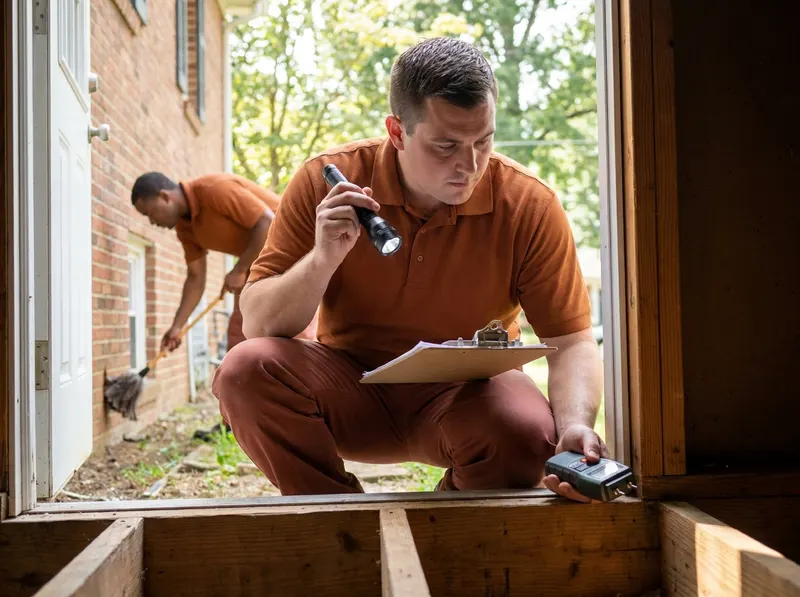
What we do differently is document before we treat. An inspector crawls the subfloor, checks the band joist and sill plate for mud tubes and frass, reads the moisture in the crawl space, looks at insulation for rodent tunneling and droppings, then works the exterior for gnaw marks at siding corners, gaps behind gutter downspouts, wasp nests under soffits and porch ceilings, and grade-level voids at the foundation. In Simmons Acres and Danville Estates we regularly see garage-to-house door sweeps worn open — a quarter-inch gap is a mouse highway. In Cherry Hill Estates and Berry Hill, shrub lines planted tight against the foundation trap moisture and give ants and camel crickets cover right up to the wall. All of it goes on the list with a photo, so you can see what we saw.
When the inspection is the right call versus jumping straight to treatment: choose the inspection when you do not yet know what you have, when you are seeing evidence but not the pest itself (droppings, shed wings, sawdust-like piles, scratching in a wall), when you are buying or renting out a property near Hallowing Point or Farmington Landing and want a baseline, or when a previous company treated repeatedly and the problem returned. Choose direct treatment when the pest is already identified and visible — a wasp nest over the front door before a weekend cookout does not need a two-hour survey. The trade-off is honest: the inspection costs money and does not kill anything by itself. What it buys is an accurate target list and a sealing plan, which is what stops the seasonal loop.
Safety questions get answered on site, not dodged. If you have a dog, kids, raised vegetable beds, or a well — common across the larger Accokeek lots near Hard Bargain Farm and the National Colonial Farm side of Bryan Point — say so during the inspection and the recommendations get built around it, including which areas we would leave untreated and use exclusion or trapping instead. Findings are quoted line by line from what the inspection actually turned up, not from a phone estimate. You are free to take the written findings and do the sealing yourself; there is no obligation attached to the visit and no contract signed at the door.
One scheduling note for Prince George's County properties: crawl space hatches, attic pull-downs, and under-sink cabinets need to be clear before arrival. If a crawl space is standing in water or blocked, we inspect what is reachable, note the limitation in writing, and tell you plainly what could not be seen. Find the entry. Seal it shut.
Every job gets a firm, written price after a free on-site visit.
Tell us about your whole-home pest inspection job in Accokeek and we'll send a clear, written quote — usually the same day.
 Vexaro Pest Services